Skip to content

SaaS Products

SaaS

Build the smallest product that can prove the business—and the foundation to grow from it.

A SaaS product begins before the dashboard: with a promise people understand, packaging they can choose, signup and payment that work, and a first-use journey that reaches value. I shape those decisions with the core product so the first release can answer a real business question.

  • Personally led
  • EN / AR bilingual
  • 12 weeks flagship build

01 / When this service fits

This is for you if…

Start with the situation your business is in. The useful scope follows from that—not from a preset package.

You have the idea, not the product

You know the problem and the customer. What's missing is a partner who can turn that into a scoped MVP — and push back on everything that can wait for version two.

You need to charge money, properly

Tiers, per-use pricing, regional payment methods, refunds — monetization is a product problem before it's a code problem, and it has to work at checkout.

The prototype can't take passengers

The demo won the meeting, but it can't take real users. You need the rebuild that keeps the validated idea and replaces the duct tape.

Self-serve has to actually serve

Without a sales team, the landing page, signup, first-use experience, and checkout need to work as one journey. Disconnected steps create friction and make product learning harder.

02 / What we can shape

What I build

01

MVP definition & build

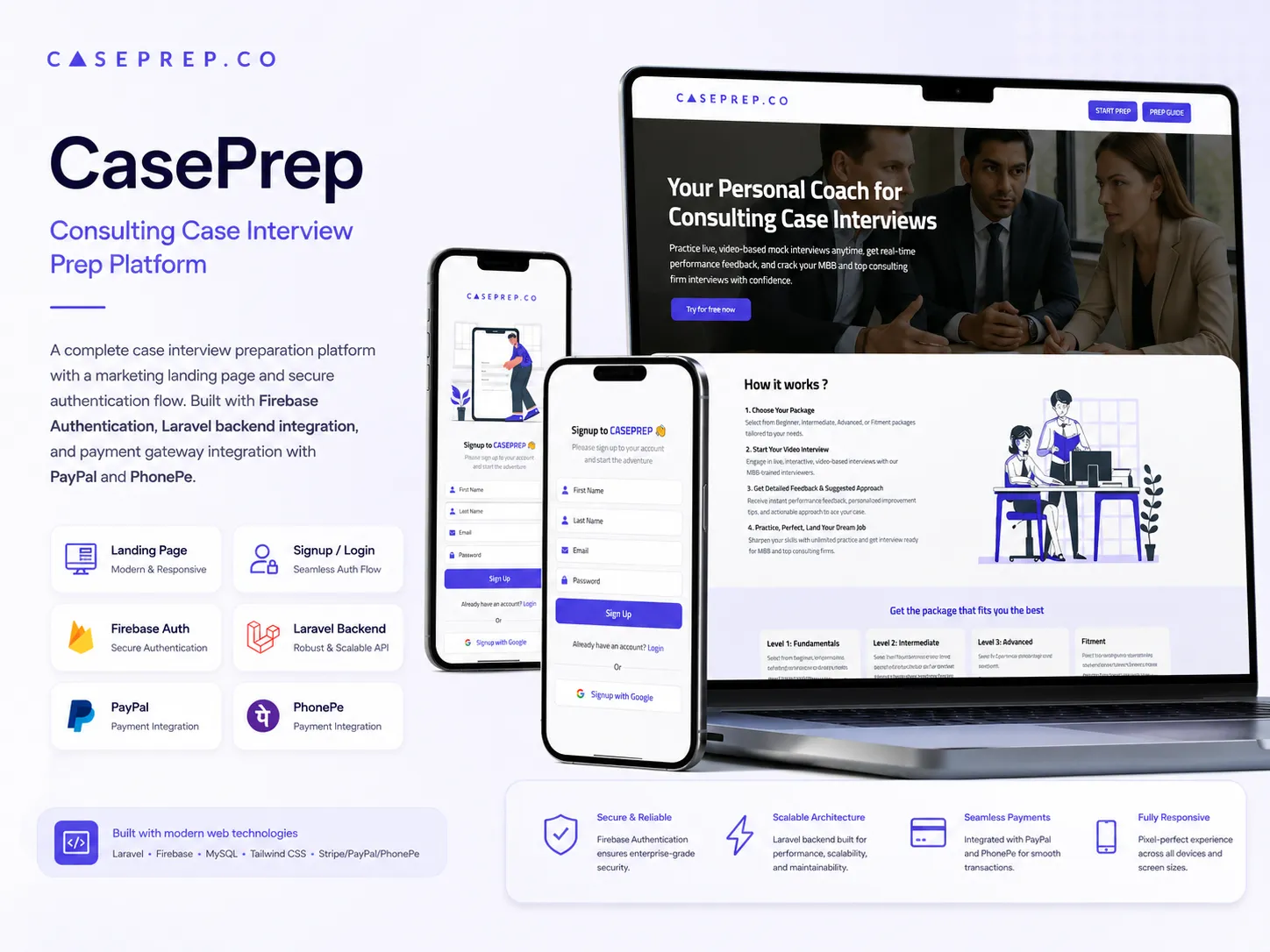
The disciplined version: map the customer journey, define the business question, cut work that does not help answer it, and plan the feedback loop. CasePrep connected packaging, authentication, regional checkout, interview practice, and feedback in one self-serve flow.
02

Packaging & monetization

Pricing turned into product: packages aligned with the customer journey—like CasePrep's interview-preparation options priced per interaction—with comparison content that makes the trade-offs clear.

03

Payments across markets

Dual payment rails can sit inside one checkout when customers span regions—PayPal and PhonePe were used for CasePrep—so the product can present an appropriate payment path per market.

04

The conversion engine

Landing pages that answer buying questions in order, lower-friction authentication, responsibly presented evidence, and measurement across the agreed funnel so the team can inspect where progression changes.

03 / What the engagement can include

What you get

  • A scoped MVP definition with an explicit not-yet list
  • Product landing page built around a clear decision and action
  • Authentication connected to first value with unnecessary steps removed
  • Subscription or per-use billing with the right payment rails
  • Terms, privacy, and refund policies wired into the product flow
  • Measurement setup for the agreed funnel stages from first visit through checkout
  • An architecture that separates the validated core from experiments
  • A post-launch iteration plan driven by real usage data

8 clear scope · one client-facing lead · visible progress

Technology chosen for the product

  • Laravel
  • Next.js
  • Firebase Auth
  • PayPal / PhonePe
  • TypeScript
  • REST APIs

Backend and payment rails are chosen per product. CasePrep used Laravel, Firebase authentication, and two payment gateways inside one checkout.

See the approach in a delivered productCasePrep

04 / How the work moves

How it ships

  1. 1Step 01

    Scope around the business question

    A focused MVP is strongest when it answers one primary question—will customers pay, return, or switch? We define that question first and scope the release around it.

  2. 2Step 02

    Design the funnel, not just the app

    The landing story, packaging, signup, and first-use experience are designed as one path. The commercial journey can be reviewed alongside the core product rather than treated as a separate launch task.

  3. 3Step 03

    Build the core, integrate the rails

    The product's heart plus the unglamorous essentials — auth, payments, policies, emails — integrated and tested end-to-end, because launch day is a terrible time to debug a checkout.

  4. 4Step 04

    Launch and read the data

    Usage signals, funnel measurement, and direct feedback provide evidence for the next iteration. The measurement plan is defined around the business question rather than generic activity.

06 / Practical answers

What clients usually need to know before we start.

Your Next Decision

Have a saas in mind? Let’s define it.

Tell me what you are building, where the work stands now, and what success should look like. We can use that context to identify the first decision worth making.

How much does an MVP cost to build?

Cost follows scope, which is why definition comes first. Discovery produces a focused MVP, an explicit not-yet list, and a written estimate tied to the business question the release is meant to test.

How quickly can we reach a launch-ready self-serve flow?

The schedule depends on the core loop, integrations, commercial rules, content, and release requirements. CasePrep is a useful scope example: accounts, an AI-guided interview flow, package selection, and regional payments were delivered as one system. Your estimate is built from the comparable parts of your product, not copied from that project.

Can you work with our existing prototype or codebase?

Yes. Sometimes the right move is extending what exists; sometimes it's a clean rebuild that preserves the validated idea. I'll give you an honest read after seeing the code — including when the answer is 'keep it'.

What if we need more capacity later?

That's the model working as intended. I stay your technical lead and single point of contact, and when the roadmap needs parallel execution — more surfaces, more disciplines — I scale delivery with trusted specialists through DevSparks.