01
Consumer apps with real-time features
Order flows, live map tracking, notifications, and payments. Laundry Heroes combined a focused order flow with step-by-step tracking from pickup through delivery.
Mobile Applications
Mobile AppI build Flutter applications for iOS and Android around the agreed service journey: the customer flow, Arabic and English experience, integrations, store release, and the operational view your team needs behind it.
01 / When this service fits
Start with the situation your business is in. The useful scope follows from that—not from a preset package.
Customers order over calls and WhatsApp, with limited pricing visibility, tracking, or history. An app can give customers a more consistent service channel while creating structured operational data.
One Flutter codebase can keep iOS and Android delivery aligned while giving each platform the attention it needs.
Late RTL retrofits often expose layout and content problems. For Gulf and Egyptian markets, Arabic direction, flow, and typography should be considered from the first design decisions.
Consumer apps that create operational work often need a control room behind them: orders, drivers, pricing, and measurement. The required operations surface should be planned alongside the app.
02 / What we can shape
Order flows, live map tracking, notifications, and payments. Laundry Heroes combined a focused order flow with step-by-step tracking from pickup through delivery.
Arabic and English flows planned together: direction-aware layouts, Arabic typography, and locale-specific details such as currency presentation within one shared codebase.
A React control room shipped alongside: drag-and-drop order boards, drivers on Google Maps, pricing management, analytics, and invoicing — the same triple-surface model that runs Laundry Heroes.
Store-release support can cover the agreed platform listings, review requirements, release preparation, and submission coordination, with external review dependencies kept visible in the plan.
03 / What the engagement can include
7 clear scope · one client-facing lead · visible progress
Technology chosen for the product
The stack used to connect the Laundry Heroes consumer app, operations dashboard, and website through one backend.
See the approach in a delivered product — Laundry Heroes04 / How the work moves
The full loop — order, fulfillment, delivery — traced for customers and staff. That defines what the app, the dashboard, and the backend each need to do.
Customer flows are designed with Arabic direction and content in mind, while staff flows prioritize the tasks they perform most often. The visual direction is shaped for the product and its category.
The app, operations dashboard, and site can be built around one shared backend, with agreed models and integration points reviewed throughout delivery.
Prepare the agreed store release, onboard the operations team, and review early product usage. Laundry Heroes used this stage to connect release preparation with dashboard onboarding and workflow refinement.
05 / Evidence in context
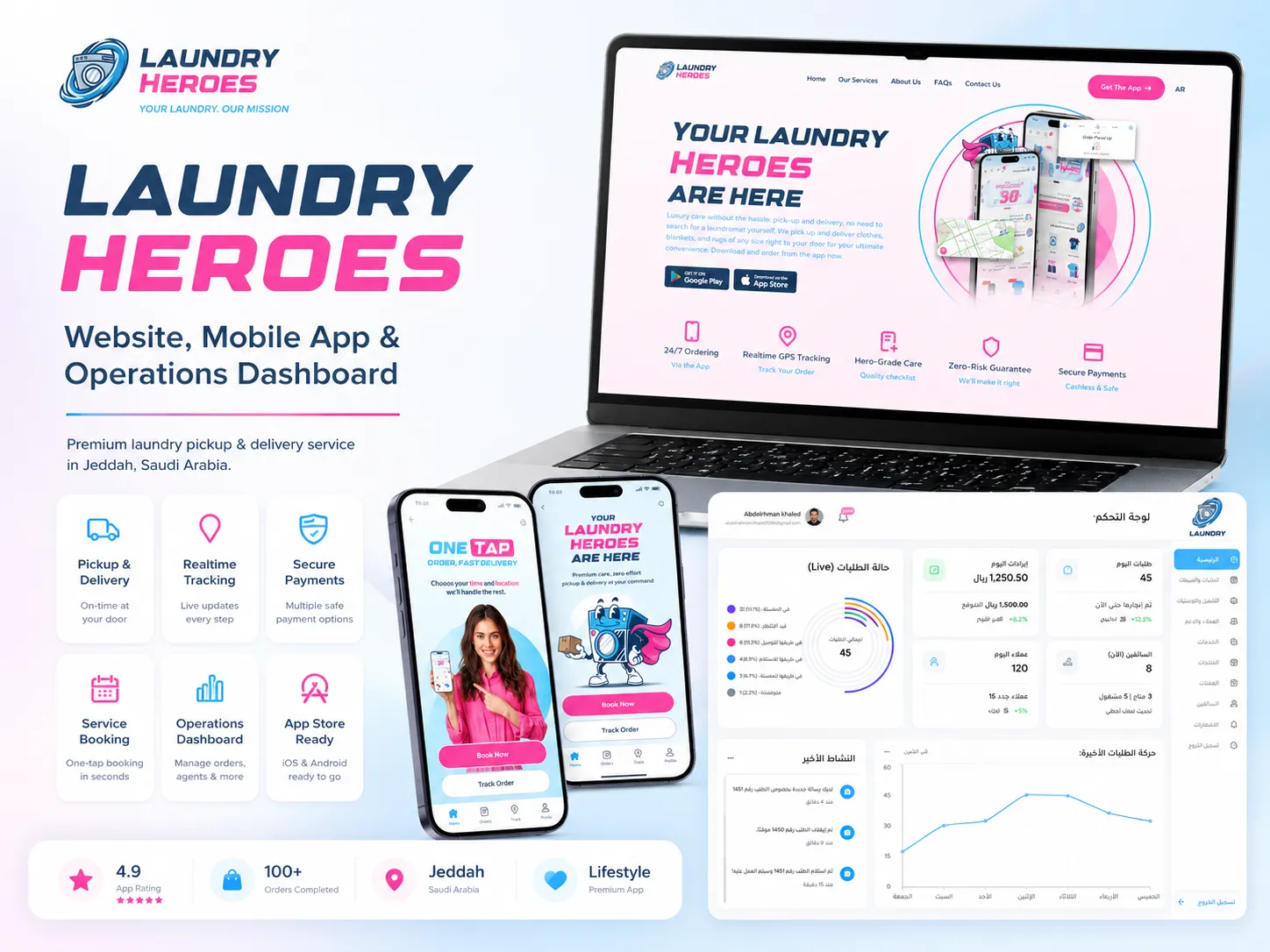
A bilingual on-demand laundry ecosystem for Saudi Arabia: one customer app, one admin dashboard that runs and manages it, and one website — connected by the same Laravel backend, brand, ordering, payment, and live-tracking flow.
Read the Case Study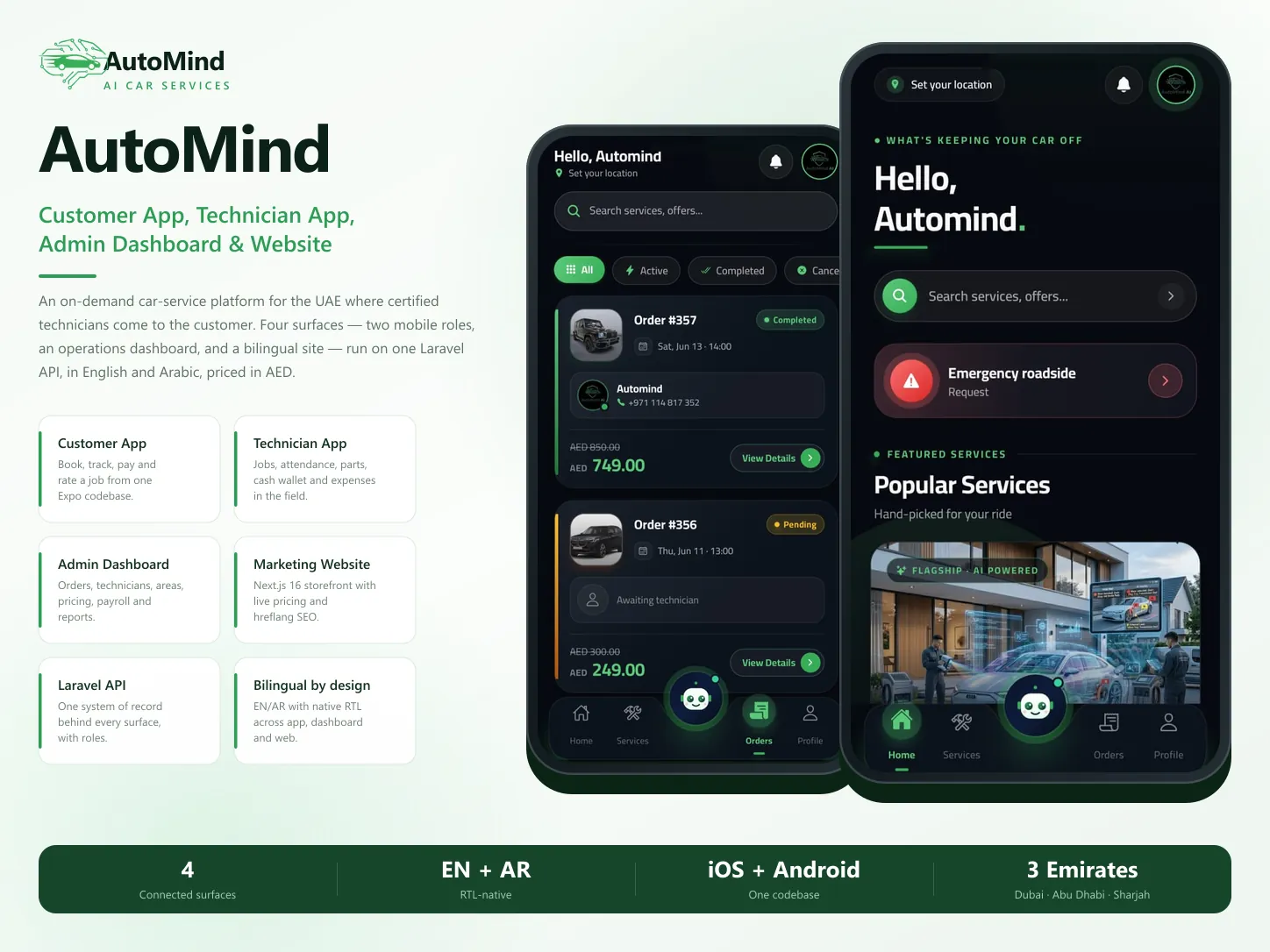
An on-demand car-service platform for the UAE built as four connected surfaces — one mobile app carrying both the customer and the technician, an operations dashboard, and a bilingual website — over a single Laravel API, with AI-written inspections, geofenced dispatch, and AED card payments.
Read the Case Study06 / Practical answers
Your Next Decision
Tell me what you are building, where the work stands now, and what success should look like. We can use that context to identify the first decision worth making.
Flutter can keep iOS and Android delivery aligned through one shared codebase while still allowing platform-specific behavior where required. The choice depends on the product's performance, hardware, and platform needs; if native development is the better fit, I will say so.
The schedule depends on customer journeys, integrations, operational tooling, content, and submission requirements. Release preparation and external store-review dependencies are included in the project plan rather than treated as an afterthought.
If the app creates operational work, the team needs an appropriate way to manage it. That may be a focused administration view or a broader control room; discovery determines what belongs in the first scope.
Store support can include developer-account guidance, localized listing preparation, review requirements, submission coordination, and release planning for the agreed platforms. The exact responsibility and external dependencies are documented in scope.